
<aside> <img src="/icons/cactus_orange.svg" alt="/icons/cactus_orange.svg" width="40px" /> I work with founders, investors, and institutions at the intersection of capital, technology, policy, and emerging markets.
</aside>
Essays, Articles, and Selected Posts
Earth has constraints no amount of engineering can remove. Every civilisation that keeps advancing eventually outgrows its origin, and ours is next. Expansion needs what Earth can't provide: energy, materials, room. Space isn't the next frontier; it's what makes the rest possible.
Until recently, space was specialist territory. In 2026, the generalists arrived: $11.3B raised across 244 deals in the first half alone, more than all of 2025, and the share of rounds crossing $100M went from 1 in 10 a year ago to nearly 1 in 3 today.
$1.8 trillion by 2035 is the projected size of the space economy. My attention is on a handful of subsectors within it.
Orbital compute is the nearest-term bet in space and the one drawing the most attention right now. AI data centers on Earth are hitting hard bottlenecks on power, land, and water, and those constraints rise every quarter. Orbit removes most of them: uninterrupted solar, no grid to connect, no land to permit, no water to cool. What it does not remove is heat. In vacuum, the only way to shed heat is to radiate it, which makes thermal management the hardest problem up there, alongside radiation slowly degrading the chips.
In late 2025, Starcloud put the first data-center-class GPU, an NVIDIA H100, into orbit on Starcloud-1, and used it to train the first AI model in space. Next comes Starcloud-2, its first commercial satellite, targeting 2027, carrying multiple GPUs including NVIDIA's Blackwell, an AWS server blade, and the largest deployable radiator ever flown on a private satellite. After that, Starcloud-3: a roughly 200 kW, three-ton spacecraft built to deploy from Starship and, if launch costs fall far enough, become the first orbital data center that competes with ground facilities on cost.
The economics are not there yet. An orbital AI data center costs roughly 3 to 4x more than its terrestrial equivalent today, driven by launch and by hardware that lasts about 5 years in orbit against 15 on the ground. The bet is that both curves bend as launch costs fall and cooling and radiation-hardening mature. I broke down the full economics a few weeks ago, linked below.
The Fastest Unicorn in Y Combinator History Is Building a Data Center in Orbit
If orbital compute uses space as a power source, in-space manufacturing uses it as a factory floor.
For as long as the ISS has existed, we've made things in orbit that we can't make as well on the ground, from optical fiber to pharmaceuticals, the leading use case for orbital manufacturing.
The reason is microgravity: with nothing pulling on them as they form, some drugs crystallise into smaller, more uniform structures than anything achievable on Earth, enough to turn a multi-hour IV drip into a simple injection. The same conditions sharpen other materials, including semiconductor crystals, a frontier that surging AI-driven chip demand has made newly worth chasing.
As the ISS retires around 2030, private companies have to step up, not only to replace the station, but to manufacture these products at scale and bring them home.

Christina Koch of NASA uses a microscope to observe and photograph growing protein crystal samples as part of the Microgravity. Media Credit: NASA.

Varda’s W-5 capsule after landing Jan. 29 (U.S. time) at the Koonibba Test Range in South Australia. Credit: Southern Launch/William Godward
Varda Space is furthest along, with six reentry capsules flown since 2023 and two more, W-8 and W-9, launched together on SpaceX's Transporter-18 this month. Its first capsule was the first commercial spacecraft to land on US soil, in Utah, under the first Part 450 reentry license the FAA ever granted. That license mattered: reentry approval was the regulatory wall keeping commercial manufacturers from returning anything they made in orbit.
The gap Varda is closing is the one Merck exposed. Merck crystallised its cancer drug Keytruda on the ISS and proved microgravity made a better formulation, but it still makes the drug on Earth. Varda's bet is to do the manufacturing in orbit and bring the finished product back.
Varda goes one step past Merck and makes the drug in orbit, not only the research, and that is where the next wave is headed. The market will split by model: some companies will own a single layer of the stack, the orbital factory or the return trip, while others will vertically integrate all of it, the iPhone model rather than Android. Varda is already the iPhone. Which model wins is the bet I am watching most closely.
All of this still depends on launching mass out of Earth's gravity well, which is exactly the constraint the next frontier removes.
Beyond Earth, asteroids and planets hold resources in a range and quantity that could reshape what humanity can build and afford. A wave of companies is going after the asteroids: AstroForge is mining near-Earth asteroids for platinum-group metals to bring back to Earth, while Karman+ is after water-rich asteroids to supply fuel and materials in space.
Planets are a different game, where only nations have the reach, and the US and China are already racing, the US through its commercial companies, China as a state. The near-term prize is the Moon's south pole, the staging point for everything beyond.
Why the Moon? Because it is the launchpad off this planet. Earth's gravity makes it brutally expensive to send anything up; the Moon has a sixth of that pull, its polar water ice splits into hydrogen and oxygen for rocket fuel, and its south pole holds the water that keeps people alive.

Source: Max Polyakov
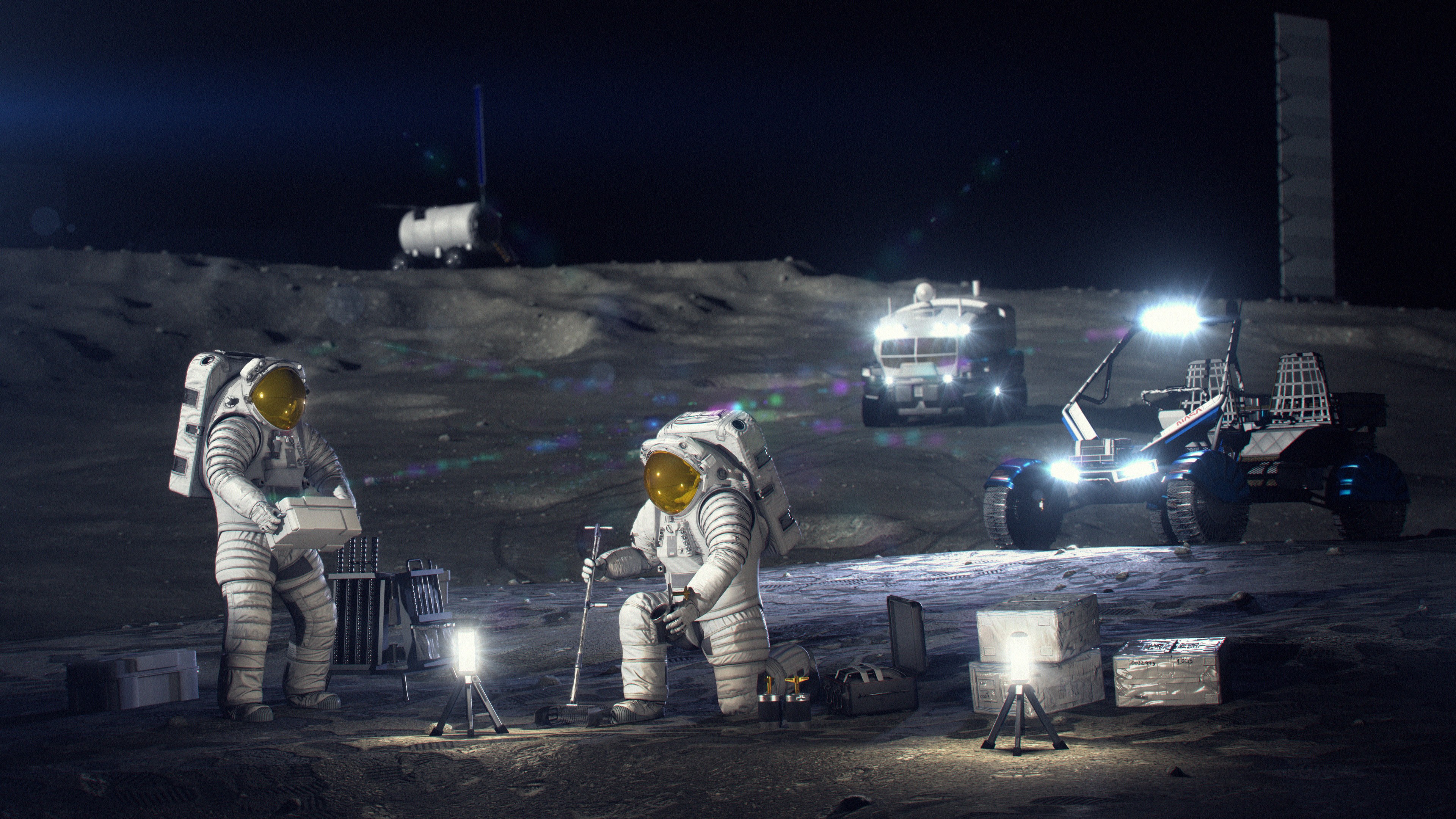
Source: NASA
The Moon is the beginning, as companies like Gru Space, Blue Origin, Lunar Resources, and ICON are already building and contributing to the infrastructure and habitats a permanent lunar economy will run on.
All of this, compute, manufacturing, resources, a lunar economy, becomes worth defending the moment it becomes worth money, and the industry saw it coming. Companies like Astranis expanded into defence because a new ground was being laid and they needed to be on it. For me, it was the next logical step, and one I care about deeply.
As space becomes a bigger share of national economic growth, defending it becomes unavoidable, the way every valuable domain eventually gets defended. A space race is not only about being first to a milestone; it is about economic stakes that run into the hundreds of billions. Whoever controls the Moon's south pole controls the staging ground beyond it, whether that is China or the US. Whoever launches fastest and cheapest sets the terms for the rest of the space economy. And as more of Earth's economy runs through orbit, more nations will move to contest it and claim their share.
The global military space market is roughly $60 billion in 2026 and is forecast to pass $80 billion by 2030, with the US accounting for about 40% of it. The US Space Force, which did not exist before 2019, has seen its budget climb from around $15 billion in 2021 to roughly $29 billion in 2025, with a 2026 request approaching $40 billion once reconciliation funding is counted. The single biggest driver is Golden Dome, the space-heavy missile shield priced at $175 billion and already creeping higher, targeting initial capability by 2028 and a full architecture around 2035.
The Space Force tapped twelve companies, including True Anomaly, Anduril, and SpaceX, to prototype space-based interceptors under agreements worth up to $3.2 billion. True Anomaly, the only startup built purely for orbital defence, raised a $650 million Series D this year (2026) at a $2.2 billion valuation, for its maneuverable Jackal spacecraft and interceptor work. Anduril's $5 billion round, at a $30.5 billion valuation, carries a space division alongside the rest of its platform. Defence tech funding set a record in 2025 and had already beaten it within five months of 2026.

Source: Wikipedia, U.S. Space Force

Source: Staff Sgt. Pedro Tenorio/Andersen Air Force Base
Space is a warfighting domain, and "space superiority" is a stated Space Force mission. China and Russia are fielding counterspace weapons, from jammers to co-orbital interceptors, which is what turns defending US space assets from theoretical into urgent.
The openings are in the layers the primes are slow to build: space domain awareness, knowing what is in orbit and what it is doing; in-space maneuver and refueling, satellites that can move, dodge, and inspect; responsive low-cost launch; and proliferated constellations cheap enough to lose and still win. These reward speed and iteration over incumbency, which is exactly where a startup beats a prime.
Compute, manufacturing, resources, and defence are my focus, but the rest of the space economy matters too, and I cover it separately below.
The remaining subsectors live here, the ones outside my focus but still worth covering. They are among the largest and most established in the space economy, but most are dominated by a handful of players, and the economics are often thinner than they look.
Launch is the clearest case, a race to the bottom on price that is not even where the launch companies make their money, as SpaceX's own filings show the bulk of its revenue coming from Starlink, not launch. The frontier subsectors I focus on above carry comparable potential with far more room to build, which is why I explore those in depth and treat these briefly below.
I've sourced and written investor-grade IMs matching the standard of top deep-tech VC firms. Here are a few from space-tech.
Intern, riidl Pre-Incubation Program (Feb 2026 - April 2026)
- Sourced and evaluated early-stage startups, reviewing pitch decks for problem-solution fit and market potential.
- Joined founder conversations from outreach through selection and managed deal flow in Airtable.
- Supported onboarding, legal structuring, and founder work on prototypes, business models, and access to mentorship and grants.
Entrepreneurship (June 2020 - Dec 2025)
- Co-founded TheCluster (2020 to 2022), managing 100+ freelancers and a full management team while owning sales, finance, and hiring.
- Served as Creative Director at Velston Clothing (2021 to 2022), leading design output and building partnerships with brands, manufacturers, and influencers.
- Founded and ran a US-incorporated solo business (2022 to 2024) monetizing writing and digital products across Medium and Twitter, handling entity setup, distribution, and revenue end to end before winding down to pursue a larger wedge.
- Founded Konrad Labs (2024 to 2025), turning that distribution into an education startup; mis-sequenced branding, legal, and fundraising ahead of product clarity and left with sharper instincts on validation, capital efficiency, and signal versus noise pre-PMF.
- Founded Seneca (2025), an on-campus autonomous delivery startup; validated demand across 100+ interviews, shipped a mobile-first MVP, and hired across multiple campuses before stepping away to back builders rather than be one.
Technical Writing (March 2022 - Nov 2024)
- Grew a Medium presence from scratch to #1 global writer in Software Engineering, Software Development, and JavaScript, earning $9,000+ in three months mostly from one article, and joined freeCodeCamp as one of its youngest technical writers.
Freelance, Web Development & UI/UX Design (July 2020 - Dec 2023)
- Delivered 10+ high-ticket UI/UX and front-end projects across three freelance studios (Senior Studios, D3luxe, Mixelate), working with clients in the US, UK, Sweden, and the gaming industry.